
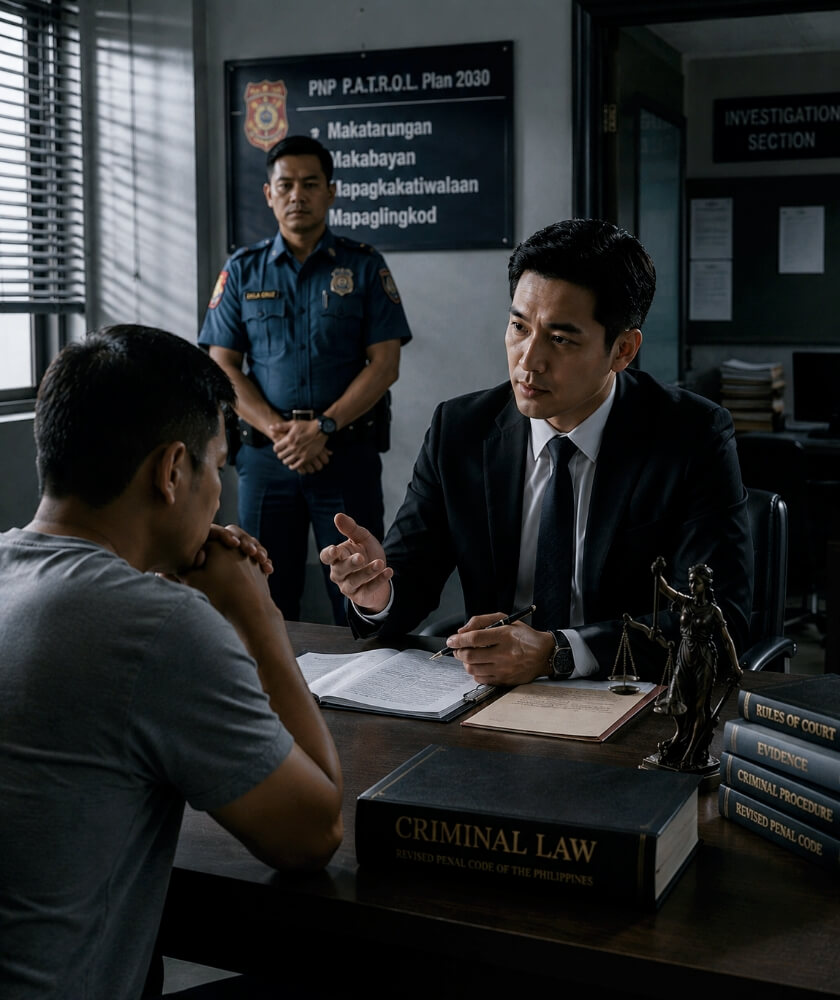
Criminal Law
In the Philippines, criminal law is a primary branch of legal practice structured to protect the state and the public by defining offenses and prescribing penalties. This practice area is heavily anchored in Book One and Book Two of the Revised Penal Code (Act No. 3815), alongside numerous statutory enactments known as Special Penal Laws (such as the Comprehensive Dangerous Drugs Act or the Cybercrime Prevention Act).
Unlike some Western jurisdictions that rely purely on adversarial jury systems, criminal litigation in the Philippines is decided exclusively by a presiding judge. Furthermore, the system allows private complainants to actively participate in the prosecution of the crime through their own lawyers, working under the supervision of government prosecutors.
SCOPE OF SERVICES - CRIMINAL DEFENSE
Criminal Defense Services
Providing legal counsel during police questioning to ensure Miranda rights are upheld and preventing coerced confessions.
Bail Applications
Preparing and filing petitions for bail or motions for the reduction of bail to secure the temporary liberty of the accused.
Preliminary Investigation
Drafting and filing Counter-Affidavits to the Prosecutor’s Office to show that no "probable cause" exists, aiming for the dismissal of charges before they reach court.
Trial Advocacy
Representing the accused during arraignment, pre-trial, and trial; cross-examining prosecution witnesses and presenting evidence for the defense.
Plea Bargaining
Negotiating with the prosecution for the accused to plead guilty to a lesser offense to receive a lighter penalty.
Appeals and Post-Cinviction Remedies
Filing appeals to the Court of Appeals or Supreme Court, and petitions for Habeas Corpus or Amparo where applicable.
SCOPE OF SERVICES - PRIVATE PROSECUTION
Case Evaluation and Filing
Assessing the merits of a victim's complaint and drafting the Complaint-Affidavit for filing with the Office of the City or Provincial Prosecutor.
Representation in Preliminary Investigation
Filing Reply-Affidavits to counter the defenses raised by the respondent.
Assistance to State Prosecutors
Acting as a "Private Prosecutor" under the direct control and supervision of the public prosecutor to prove the civil liability arising from the crime and assist in proving criminal guilt.
Application for Provisional Remedies
Seeking preliminary attachment or injunctions to protect the interests of the victim during the pendency of the case.
TYPES OF CLIENTS SERVED - INDIVIDUALS
The Accused (Defendants)
Individuals charged with crimes ranging from "Light Felonies" (e.g., slight physical injuries) to "Heinous Crimes" (e.g., murder, large-scale drug trafficking).
Victimes (Complainants)
Individuals seeking justice for crimes committed against their person, property, or honor.
Indigent Litigants
Low-income individuals served by the Public Attorney’s Office (PAO) or pro-bono legal aid clinics.
Public Officers
Government employees or officials facing charges related to their official functions, such as graft and corruption (often tried in the Sandiganbayan).
TYPES OF CLIENTS SERVED - CORPORATE & INSTITUTIONAL
Corporations
Businesses acting as complainants in cases of "Estafa" (fraud), qualified theft by employees, or intellectual property violations.
Corporate Officer
Executives facing "White-Collar" criminal charges like money laundering, tax evasion, or violations of the Securities Regulation Code.
Foreign Nationals
Aliens arrested within Philippine territory who require specialized counsel familiar with both local laws and diplomatic/consular protocols.
COMMON LEGAL ISSUES HANDLED
Crimes Against Persons
Homicide, murder, physical injuries, and domestic violence cases (under the Anti-Violence Against Women and Their Children Act).
Crimes Against Property
Theft, robbery, malicious mischief, and Estafa (swindling/fraud), alongside violations of the Bouncing Checks Law (B.P. 22).
Drug-Related Offenses
Charges concerning the possession, sale, or manufacturing of illegal substances under the Comprehensive Dangerous Drugs Act.
White-Collar & Regulatory Crimes
Corporate fraud, tax evasion, anti-money laundering violations, and graft and corruption cases handled by the Sandiganbayan (anti-graft court).
Cybercrimes
Contemporary digital offenses including internet fraud, online libel, identity theft, and hacking.
Negligence & Quasi-Offenses
Reckless imprudence resulting in damage to property or physical injuries, frequently stemming from vehicular accidents.
APPROACH TO HANDLING MATTERS
Fact-Finding & Evidence Auditing
Scrutinizing police blotters, arrest reports, forensic tests, and witness statements to find inconsistencies in the prosecution’s narrative or violations of constitutional due process (such as unlawful searches).
Strategic Litigation
Navigating the technicalities of the courtroom. Defense attorneys focus on establishing "reasonable doubt," while private prosecutors focus on fulfilling the elements of the crime.
Negotiation Intervention
While litigation is the core focus, case management is increasingly negotiation-driven during the pre-trial phase due to court-mandated plea bargaining frameworks designed to declog judicial dockets.
